Most companies want more feedback from employees.
Ideas. Concerns. Friction in the workplace. Things leadership doesn’t see.
The challenge is getting people to actually speak up.
Two types of tools are commonly used to collect that feedback:
-
Anonymous feedback tools
-
Employee engagement platforms
At first glance, they sound similar. Both collect employee input. Both sit somewhere in the HR or people-ops stack.
But they solve very different problems.
Anonymous feedback tools are designed to let employees share thoughts without revealing their identity. When people know their name isn’t attached, they’re much more likely to speak honestly about workplace issues or improvement ideas.
Employee engagement platforms take a different approach. They focus on measuring engagement across the organization using surveys, dashboards, and analytics. HR teams use them to track sentiment, identify trends, and monitor workplace culture over time.
Because both tools involve collecting employee feedback, they often get grouped together.
But the way they collect feedback, the kind of insights they generate, and the problems they’re meant to solve are not the same.
In this guide, we’ll break down:
-
what anonymous feedback tools are
-
what employee engagement platforms do
-
the key differences between them
-
when each type of tool makes the most sense
Once you understand the difference, choosing the right approach becomes much easier.
What Is Anonymous Employee Feedback Software?
Anonymous employee feedback software is built for one main purpose: letting employees share input without revealing who they are.
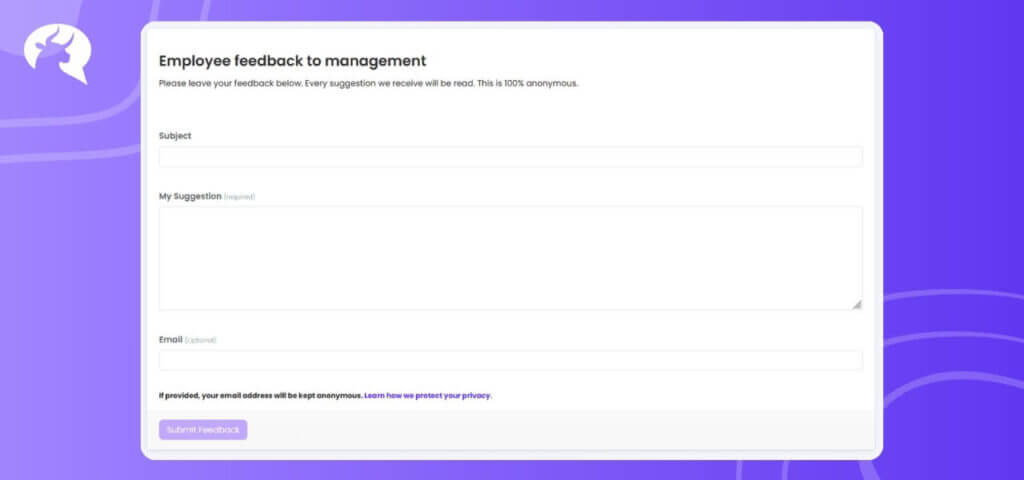
These tools remove identifying information so feedback can’t be traced back to the person who submitted it.
That simple change makes a big difference.
When employees know their identity is protected, they’re far more likely to speak openly about problems, concerns, or ideas for improvement.
Instead of filtering their thoughts or staying silent, they can just say what’s on their mind.
Key Features of Anonymous Feedback Tools
Most anonymous feedback tools focus on collecting input safely and then helping teams respond to it.
Typical features include:
-
anonymous suggestion boxes
-
anonymous feedback forms
-
secure submission channels
-
anonymous follow-up conversations
-
internal workflows to review and resolve feedback
The goal isn’t just to collect feedback. It’s to make sure someone can review it and act on it.
Typical Use Cases
Companies usually introduce anonymous feedback tools when employees need a safer way to raise issues.
Common scenarios include:
-
collecting employee suggestions
-
reporting workplace concerns
-
surfacing cultural issues
-
capturing improvement ideas
-
providing a safe reporting channel
An anonymous suggestion box, for example, gives employees a simple way to share ideas or concerns at any time without fear of repercussions.
Because these tools focus on individual submissions rather than aggregated survey data, they’re particularly useful for surfacing specific problems or suggestions inside a company.
Examples of Anonymous Feedback Tools
You’ll typically see these tools described as:
-
anonymous suggestion box software
-
anonymous employee feedback platforms
-
workplace reporting tools
All of them share the same core idea: make it safe for employees to speak honestly.
Tools like Suggestion Ox are designed specifically for anonymous employee feedback. They work like a digital suggestion box where employees can safely submit ideas, concerns, or questions without attaching their name to the submission. Platforms like Suggestion Ox’s anonymous suggestion box make it possible to collect candid feedback while still allowing managers to review and respond to it.
What Are Employee Engagement Platforms?
Employee engagement platforms take a different approach to employee feedback.
Instead of collecting individual suggestions or concerns, these tools focus on measuring how employees feel about their work and the company overall.
They do this mostly through surveys.
HR teams use them to track things like satisfaction, motivation, culture, and trust in leadership. The goal is to understand patterns across the organization and improve the overall employee experience.
Core Capabilities of Engagement Platforms
Most engagement platforms combine several types of feedback tools in one system.
Common capabilities include:
-
employee engagement surveys
-
pulse surveys
-
sentiment tracking
-
analytics dashboards
-
recognition programs
-
performance and feedback tools
The surveys themselves can be quite structured.
Instead of open-ended submissions, employees answer questions designed to measure specific parts of the workplace experience, like communication, leadership, or work-life balance.
Pulse Surveys and Continuous Listening
One of the most common tools inside engagement platforms is the pulse survey.
Pulse surveys are short questionnaires sent to employees regularly. They’re designed to capture feedback quickly and track how employee sentiment changes over time.
Because they run frequently, pulse surveys give HR teams a continuous view of employee engagement rather than a single snapshot once a year.
Instead of asking “How engaged are employees right now?” once annually, organizations can track trends month by month.
Examples of Engagement Platforms
Engagement platforms usually appear in categories like:
-
employee engagement software
-
employee experience platforms
-
HR listening tools
-
pulse survey platforms
Many of them combine surveys, analytics, and recognition tools into a single system that helps HR teams monitor workforce sentiment and improve workplace culture over time.
Anonymous Feedback Tools vs Employee Engagement Platforms: Key Differences
Now that we’ve defined both categories, the differences become clearer.
Anonymous feedback tools and employee engagement platforms both collect employee input. But they’re designed for different kinds of insight.
One focuses on individual issues and suggestions.
The other focuses on measuring engagement across the organization.
Here are the main differences.
Primary Purpose
Anonymous feedback tools exist to help employees speak up safely.
The goal is simple: remove the fear of being identified so employees can share concerns, ideas, or criticism honestly.
These tools are often used for things like workplace issues, culture problems, or employee suggestions that might otherwise stay unspoken.
Employee engagement platforms serve a different purpose. They help HR teams measure engagement and sentiment across the workforce using surveys and analytics.
Instead of surfacing individual issues, they’re designed to identify trends in morale, satisfaction, and workplace experience.
Type of Feedback Collected
Anonymous feedback tools collect open-ended submissions.
Employees can usually write whatever they want:
-
suggestions
-
concerns
-
questions
-
improvement ideas
This type of feedback tends to be qualitative and specific.
Employee engagement platforms collect feedback in a more structured way.
Most rely on engagement surveys and pulse surveys, where employees answer predefined questions about their work experience.
These surveys produce measurable data that HR teams can analyze across departments or over time.
Level of Anonymity
Anonymous feedback tools typically provide full anonymity.
That means the system is designed to avoid collecting identifying information about the person submitting feedback.
The goal is to make it safe for employees to speak openly without worrying about repercussions.
Engagement platforms usually operate differently.
Many use confidential surveys rather than fully anonymous ones, which means responses may still be linked to internal data like department or tenure to support analysis.
This helps HR teams understand patterns in engagement across the organization.
Data and Insights
Anonymous feedback tools produce issue-level insights.
For example:
-
“There’s a problem with how shifts are scheduled.”
-
“Managers aren’t communicating clearly.”
-
“Here’s an idea to improve onboarding.”
These tools surface specific issues raised by individual employees.
Employee engagement platforms generate aggregated insights.
They show patterns such as:
-
engagement scores
-
sentiment trends
-
satisfaction with leadership
-
changes in morale over time
This helps organizations understand how employees feel about the workplace at a broader level.
Workflow and Actionability
Anonymous feedback tools often include workflows to review and respond to individual submissions.
That might involve:
-
assigning feedback to a manager
-
investigating an issue
-
responding to the employee anonymously
-
tracking resolution
Employee engagement platforms work differently.
They typically provide analytics dashboards and reporting tools so HR teams can analyze engagement data and identify areas that need improvement.
Instead of resolving individual issues, the focus is on organizational trends and engagement strategy.
When Anonymous Feedback Tools Are the Better Choice
Anonymous feedback tools work best when employees need a safe way to speak openly.
In many organizations, people hesitate to raise concerns if their name is attached to the feedback. Fear of retaliation, conflict, or being labeled a troublemaker can stop employees from sharing what they really think. Anonymous channels remove that barrier and make it easier for employees to provide candid input.
That’s why these tools are often used in situations where honesty matters more than structured measurement.
Sensitive Workplace Issues
Anonymous feedback is particularly useful when employees may be reporting sensitive problems.
Examples include:
-
workplace misconduct
-
management concerns
-
culture or inclusion issues
-
safety problems
When anonymity is guaranteed, employees are more likely to share information they would otherwise keep to themselves.
This helps leadership surface issues early before they escalate.
In some cases organizations also implement anonymous reporting tools for employees, which allow workers to report serious concerns while protecting their identity.
Encouraging Honest Employee Input
Some companies introduce anonymous feedback tools simply because employees are reluctant to speak up in meetings or surveys.
Without anonymity, feedback tends to become cautious and filtered. People avoid criticism or difficult topics.
Anonymous channels change that dynamic.
By protecting identity, these systems encourage more honest and direct responses, which often leads to more accurate insights about workplace problems.
Capturing Suggestions and Ideas
Anonymous feedback tools are also useful for collecting ideas.
Employees often have suggestions for improving workflows, fixing inefficiencies, or solving everyday problems. But many hesitate to share them publicly.
An anonymous suggestion box removes that hesitation. Employees can submit ideas quickly without worrying about how they might be perceived.
This makes it easier for organizations to capture ideas that might otherwise never surface.
Anonymous suggestion boxes are often used because they make it easier for employees to share ideas without fear of backlash, which is why many companies still run anonymous suggestion box programs.
Organizations Building Trust and Psychological Safety
Finally, anonymous feedback tools can help organizations build a culture where employees feel heard.
When people know they can safely raise concerns or ideas, they’re more likely to participate in improving the workplace.
Anonymous feedback creates a channel for that kind of participation, helping organizations understand what employees are experiencing and what needs to change.
In practice, many companies start with a simple anonymous employee feedback form that allows employees to share concerns without attaching their name to the submission.
When Employee Engagement Platforms Are the Better Choice
Employee engagement platforms make more sense when the goal is measuring engagement across the organization, not collecting individual anonymous submissions.
Instead of surfacing specific issues one at a time, these tools help HR teams understand broader patterns in how employees experience their work.
They usually do this through structured surveys and analytics.
Measuring Engagement Across the Organization
Employee engagement platforms are designed to answer questions like:
-
How engaged are employees overall?
-
Which teams feel disconnected from leadership?
-
Are engagement scores improving or declining?
To answer these questions, the platforms typically rely on engagement surveys that measure factors such as satisfaction, recognition, clarity of expectations, and connection to company goals.
Instead of focusing on individual comments, the system aggregates responses and turns them into metrics that leadership can track over time.
Running Structured Surveys
A common feature in engagement platforms is the employee engagement survey.
These surveys usually include dozens of standardized questions designed to measure different aspects of the workplace experience, such as leadership, communication, or career growth.
The results give organizations measurable insight into how employees feel about their work and the company.
Tracking Trends Over Time
Another advantage of engagement platforms is the ability to monitor sentiment continuously.
Many systems use pulse surveys, which are short surveys sent regularly to capture feedback and track changes in engagement levels.
Because these surveys run frequently, organizations can see trends develop over time instead of relying on a single annual snapshot.
This makes it easier to detect emerging problems early and measure whether workplace improvements are actually working.
Supporting HR Strategy and Organizational Planning
Employee engagement platforms also provide analytics dashboards that help HR teams interpret survey data and identify patterns across the workforce.
These systems turn employee sentiment into measurable signals that leadership can analyze and act on.
Instead of resolving individual issues, the focus is on identifying trends, prioritizing improvements, and shaping long-term engagement strategy.
For organizations that want to understand workforce sentiment at scale, engagement platforms provide the structured data needed to guide those decisions.
Can Organizations Use Both?
Yes. And many companies do.
Anonymous feedback tools and employee engagement platforms are often used together because they solve different problems.
One captures individual issues and ideas.
The other measures overall engagement and sentiment across the organization.
Used together, they create a more complete picture of what employees are experiencing.
Anonymous Feedback Surfaces Issues
Anonymous feedback tools are good at surfacing specific problems or suggestions.
An employee might report:
-
a management issue
-
a process that isn’t working
-
an idea for improving how something is done
Because submissions are anonymous, people tend to speak more openly. Research shows employees are more likely to share honest feedback when they feel their identity is protected.
These tools help organizations uncover issues that might never appear in surveys.
Engagement Platforms Measure Sentiment
Employee engagement platforms focus on measuring workforce sentiment at scale.
Instead of individual comments, they analyze patterns across the organization using surveys and analytics.
For example, engagement platforms help answer questions like:
-
Are employees feeling more or less engaged this quarter?
-
Which teams have the lowest engagement scores?
-
Are changes to leadership or policy affecting morale?
These systems help organizations track engagement trends and turn employee feedback into measurable insights for leadership decisions.
A Combined Feedback Strategy
Because both approaches provide different kinds of insight, many organizations use them together.
A typical setup might look like this:
-
Anonymous feedback channel → captures concerns, ideas, and issues
-
Engagement platform → measures sentiment and tracks trends over time
This combination allows organizations to capture both individual feedback and broader engagement data, creating a more complete understanding of the employee experience.
How to Choose the Right Approach
For organizations that want a simple way to collect anonymous suggestions and concerns, tools that are quick to deploy and easy to manage — like those described in how anonymous feedback systems work — can be a practical starting point.
Choosing between anonymous feedback tools and employee engagement platforms starts with a simple question:
What kind of insight are you trying to get from employees?
Both types of tools collect feedback. But they’re designed to answer different kinds of questions.
Once you’re clear about the goal, the right choice usually becomes obvious.
Define the Type of Feedback You Need
If the goal is to surface specific issues, concerns, or ideas, anonymous feedback tools are often the better option.
These systems allow employees to submit open-ended feedback without revealing their identity. That makes it easier for people to speak honestly about problems or improvements that might otherwise stay hidden. Research shows employees are significantly more likely to provide candid feedback when anonymity is guaranteed.
If the goal is to measure engagement levels across the organization, engagement platforms are usually the right choice.
These tools use surveys and analytics to track workforce sentiment and identify trends over time. HR teams can monitor engagement scores, participation rates, and sentiment changes across departments or teams.
Consider the Type of Insight You Want
Anonymous feedback tools produce issue-level insight.
For example:
-
a concern about management communication
-
a suggestion for improving onboarding
-
a complaint about an internal process
These systems are good at uncovering individual problems or ideas inside the organization.
Engagement platforms produce trend-level insight.
They help answer questions like:
-
Are employees becoming more engaged or less engaged over time?
-
Which teams have lower engagement scores?
-
How do employees feel about leadership or company culture?
Instead of individual submissions, the focus is on patterns across the workforce.
Think About How You Plan to Act on the Feedback
Another factor is how the feedback will be used once it’s collected.
Anonymous feedback tools often support workflows for reviewing and responding to individual submissions. Someone can investigate a concern, assign ownership, or respond anonymously to the employee.
Engagement platforms work differently. They aggregate responses and present them in dashboards so HR teams can analyze sentiment and prioritize organizational improvements.
Both approaches are valuable. They just operate at different levels.
The Practical Decision Rule
In simple terms:
-
If you want to hear what employees are afraid to say openly, use anonymous feedback tools.
-
If you want to measure engagement and track workplace sentiment, use engagement platforms.
Many organizations eventually use both.
Anonymous channels help uncover issues and ideas, while engagement platforms provide the broader data needed to understand how the workforce feels overall.
Together, they give leadership a clearer view of what’s actually happening inside the company.
Summary Comparison
At this point, the difference between the two approaches should be clear.
Anonymous feedback tools focus on surfacing honest input from individual employees.
Employee engagement platforms focus on measuring engagement trends across the organization.
Here’s a quick side-by-side summary.
| Category | Anonymous Feedback Tools | Employee Engagement Platforms |
|---|---|---|
| Primary purpose | Collect candid feedback and suggestions | Measure engagement and sentiment across teams |
| Feedback format | Open-ended submissions | Structured surveys and pulse surveys |
| Anonymity | Fully anonymous submissions | Often confidential rather than fully anonymous |
| Type of insight | Individual issues, ideas, and concerns | Aggregated engagement scores and trends |
| Typical features | Suggestion boxes, anonymous conversations, reporting workflows | Surveys, analytics dashboards, sentiment tracking |
| Best use case | Surfacing sensitive feedback or ideas | Tracking employee engagement over time |
Employee engagement platforms are typically designed to measure employee sentiment and track engagement trends using surveys and analytics tools.
NOTE: If you’re evaluating different anonymous feedback tools, it can also help to review alternatives to Suggestion Ox and other suggestion box platforms.
Final Thoughts
Anonymous feedback tools and employee engagement platforms both play an important role in understanding what employees experience at work.
But they solve different problems.
Anonymous feedback tools help organizations hear what employees might not say openly. They surface concerns, suggestions, and ideas that might otherwise stay hidden.
Employee engagement platforms help organizations measure how employees feel overall. Through surveys and analytics, they show patterns in engagement, satisfaction, and workplace culture.
Many organizations eventually use both approaches.
Anonymous channels capture individual issues and ideas. Engagement platforms provide the broader data needed to understand sentiment across the workforce.
Used together, they give leadership a clearer picture of what’s happening inside the organization—and where improvements are needed.
Tools like Suggestion Ox focus specifically on anonymous employee feedback.
The idea is simple: give employees a way to share ideas, concerns, or questions without attaching their name to it. When identity isn’t part of the equation, people are much more likely to speak honestly about what’s actually happening inside the company.
In environments where employees hesitate to speak openly, dedicated anonymous feedback tools create a safer channel for surfacing issues, suggestions, and workplace problems before they grow into bigger ones.